William JohnMcCOLLUM
Bill to his family. He grew up on Grenadier Road in Toronto, joined the air force at eighteen to fix aeroplanes, and spent two years on the ground before he got into one. He flew nine operations as a rear gunner in the summer of 1944. On the ninth his Lancaster was shot down over France, and he was killed at twenty-one. This is his story, and the story of the family and the French village that kept it.
- Born
- Toronto, 24 September 1922
- Enlisted
- Galt, Ontario, 19 July 1941
- Served
- Rear gunner, No. 576 Squadron RAF
- Rests
- Loches-sur-Ource, France
Grenadier Road
Bill was the son of John McCollum, born in Ireland, and Elsie McCollum, born in London, and grew up on Grenadier Road in Toronto. His father had sailed from Belfast in 1907 and served with the Canadian Railway Troops in the First World War.
An older brother, Alexander, and a sister, Mary, died young, so Bill grew up the eldest. He had two brothers, Robert (Bob), who served in the navy on a Canadian minesweeper, and John (Jack), and five sisters: Anne, Eileen, Doris, Joan and Margaret.
He went to St Vincent de Paul school, then De La Salle Oaklands and Parkdale Collegiate, and in 1940 did a year’s industrial course at Western Technical School. He played baseball; the family also remembers hockey, and riding in rodeos. He trained at the aircraft school in Galt, and his pay book gives his civilian job as a sectionman on the Canadian National Railways.
Into the air force
He enlisted in the RCAF at Galt, Ontario, on 19 July 1941, not as aircrew but as ground crew, training as an airframe mechanic. His training took him to Toronto, Calgary, St Thomas and Brantford, and in December 1942 he sailed from Halifax for Britain. For the first months of 1943 he was ground crew with No. 421 Squadron RCAF, a Spitfire squadron.
In May 1943 he remustered as an air gunner. Michael McCollum, who read his full file in Ottawa in 1992, quotes it describing him as “intelligent and well educated, quiet and a deliberate thinker with a sense of responsibility.” He had the marks to train as a pilot, navigator or bomb aimer, but took air gunner because it was the quickest way into a crew; the selection board noted he was “keen to get cracking”.
He trained at Bridlington and Bridgnorth, and finished his gunnery course at Bishops Court in Northern Ireland on 25 September 1943 with his air gunner’s badge and a sergeant’s stripes. Then came the long build-up: Wellingtons at 30 Operational Training Unit, Hixon; Halifaxes at 1656 Heavy Conversion Unit, Lindholme; Lancasters at 1 Lancaster Finishing School, Hemswell. In May 1944 he joined an operational squadron, two years and ten months after he enlisted.
Service
- Born in Toronto.
- Enlists at Galt, Ontario. Aircraftman 2nd class, airframe mechanic.
- Leading Aircraftman.
- Overseas to Britain.
- No. 421 Squadron RCAF, ground crew.
- Sergeant, air gunner.
- No. 550 Squadron, North Killingholme. Rear gunner in P/O Ken Newman’s crew. Three operations over Germany.
- No. 576 Squadron, Elsham Wolds. Rear gunner in P/O Raymond Linklater’s crew.
- Flight Sergeant. The squadron paperwork never caught up, and still lists him as Sergeant three weeks later.
- Killed when ND994 is shot down returning from Revigny.
Library and Archives Canada
On paper
Bill’s service file survives at Library and Archives Canada. Most of it is forms: postings, pay, inoculations. In between, the forms catch something of the young man filling them in.
The oldest paper in the file is a reference written when he was seventeen by John E. Madden of Toronto, who knew him, his father and his uncle. Someone later wrote “To RCAF” across the top.
He filled in his attestation paper himself on 16 June 1941, aged eighteen. Asked what he wanted to do in the air force, he wrote “Air Frame Mechanic”. Sports: “Baseball, moderately”. Hobbies, and special qualifications useful to the RCAF: “None”. Flying experience, solo, dual or as a passenger: “None”. He had never been up in an aeroplane.
The medical at enlistment found him five foot six and 128 pounds, fair, with blue eyes and blond hair, and noted a left wrist he had broken at fourteen. At Calgary that September the medical board put his physique down as “wiry” and his athletics as “average at most sports”, and recorded that he smoked fifteen to twenty cigarettes a day and drank a pint of beer a month.
At No. 12 Air Gunners School he scored 81.5 per cent on the ground subjects. In the air, firing from the turret of an Anson, he put 2,000 rounds at the target and hit it with 3.1 per cent of them. The school gave him 60 out of 100 for character and leadership, and marked him “not at all suitable” to teach gunnery. He passed anyway, with his badge and his sergeant’s stripes. By then the school measured him at five foot eight.
At 30 Operational Training Unit, Hixon, his report names his captain: Sgt Newman, whose crew would take him to war in May 1944. He scored 80.9 per cent on the ground. In the air he completed two air-to-air firing exercises; under percentage hits, the report says “nil”. The unit’s commanding officer summed him up in three sentences.
On 28 October 1943, at Hixon, he picked up the only charge of his service: urinating outside the station guardroom, as the conduct sheet reads, witnessed by a corporal of the service police. He was reprimanded. Every unit he served with afterwards signed the sheet “no further entry”, the last of them 576 Squadron on 5 July 1944, ten days before he died.
On 29 June 1944 a new RCAF identity card, number 044868, was entered in his pay book. Sixteen days later it was the card Roland Favier and the mayor found in his jacket at Basse Maison, and the number the mayor wrote into the Essoyes register of deaths.
Nine operations
Bill flew nine operations in fifty-five days, every one as rear gunner. The first three were high-level attacks on German cities. The last six, after D-Day, were over France: a V-weapon site, railway targets, and the battle for Caen. On his third, over Aachen, a night fighter engaged his aircraft. The squadron recorded the combat as inconclusive: the German broke it off.
“Getting away from the target your Uncle Bill reported twice that we had a night-fighter on our tail, so each time I corkscrewed the aircraft and we eventually lost it.”
At the end of May the Newman crew was posted out of 550 Squadron, and in June Bill joined Raymond Linklater’s crew at 576 Squadron, Elsham Wolds. Linklater’s crew flew no operation in June. Their first together was a daylight raid on a V-weapon site on 2 July.
| No. | Night | Target | Aircraft | Notes |
|---|---|---|---|---|
| No. 550 Squadron, pilot P/O K. J. Newman | ||||
| 1 | 21/22 May 1944 | Duisburg | LL796 “O” | Bombed from 23,000 ft. Three of the squadron’s crews failed to return. |
| 2 | 22/23 May 1944 | Dortmund | ME193 “C” | Bombed from 18,000 ft. |
| 3 | 24/25 May 1944 | Aachen, marshalling yards | ME193 “C” | Engaged by a night fighter. “Inconclusive, the enemy breaking off the engagement.” |
| No. 576 Squadron, pilot P/O R. E. Linklater | ||||
| 4 | 2 Jul 1944 | Domléger, V-weapon site | ND859 “L2” | Daylight, fighter escort. Bombed from 14,000 ft. |
| 5 | 4/5 Jul 1944 | Orléans | NE854 “D2” | One of the squadron’s crews failed to return. |
| 6 | 5/6 Jul 1944 | Dijon, marshalling yards | JA868 “V2” | Diverted to Coningsby on return. |
| 7 | 7 Jul 1944 | Caen | ND859 “L2” | “A message of appreciation was received from the 2nd Army in Normandy.” |
| 8 | 12/13 Jul 1944 | Revigny, railway yards | ND994 “F2” | Marking failed; ordered home with bombs. |
| 9 | 14/15 Jul 1944 | Revigny, railway yards | ND994 “F2” | Failed to return. |
ND859, which Bill flew on two of these, was lost with another 576 crew on the first Revigny raid, two nights before he died. ND994 was normally flown by P/O V. Moss’s crew. Linklater’s crew took it out twice.
The crew
Five Canadians and two Englishmen. None survived. Ranks and details are as the Commonwealth War Graves Commission records them. Photographs from the families’ collections; none has yet been found of John Pringle.
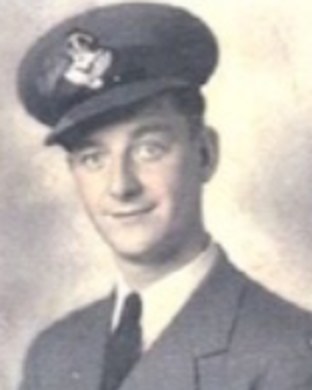 PilotF/O Raymond Edwin LinklaterRCAF, J/25837
Row 3, Grave 3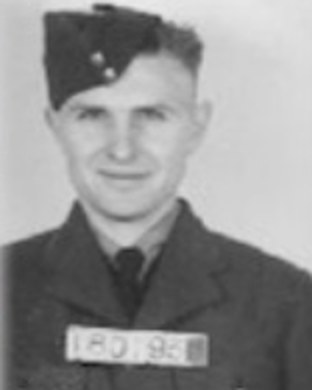 NavigatorF/Sgt Stanley John KozlowskiRCAF, R/180195
Row 3, Grave 2- No photograph yetFlight engineerSgt John Wellington Gordon PringleRAFVR, 2211889, age 27
Son of Russell and Alice Maud Pringle; husband of Barbara Pringle, of Hightown, Lancashire
Row 1, collective grave 6–7GOD BLESS 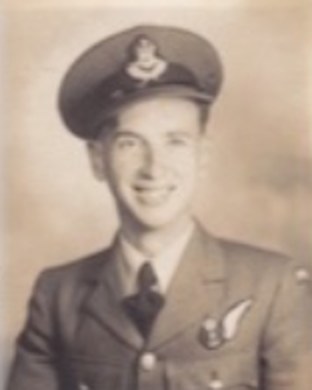 Air bomberF/O Donald McKenzie MackintoshRCAF, J/29691
Row 1, collective grave 6–7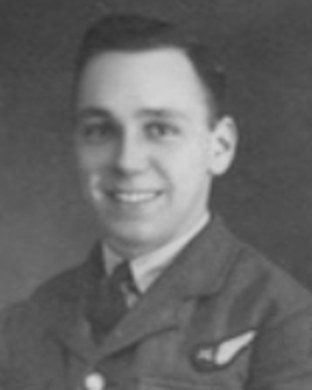 Wireless operator / air gunnerSgt William Walker BeattieRAFVR, 1532959, age 20
Son of William Storey Beattie and Elizabeth Jane Beattie, of Hylton, Co. Durham
Row 1, collective grave 6–7THEY DIED THAT OTHERS MIGHT LIVE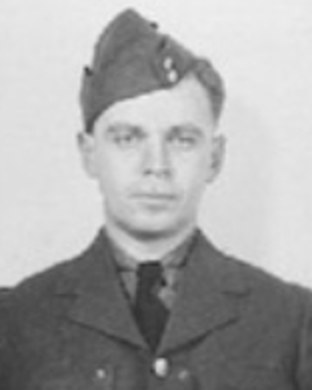 Mid-upper gunnerF/Sgt George Robert SimsRCAF, R/208935
Row 1, collective grave 6–7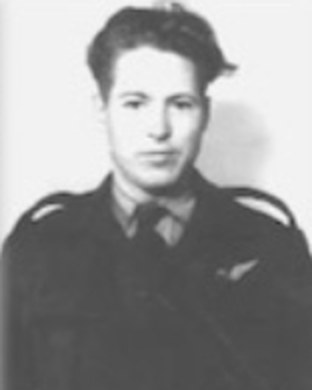 Rear gunnerF/Sgt William John McCollumRCAF, R/118907, age 21
Son of John and Elsie McCollum, of Toronto
Row 3, Grave 4HE DIED THE HELPLESS TO DEFEND A FAITHFUL AIRMAN’S NOBLE END
The last flight
Twelve Lancasters of 576 Squadron took off from Elsham Wolds to bomb the railway yards at Revigny-sur-Ornain. ND994 was airborne at 21:16. It was the second attempt on the target in three nights, and it went the same way as the first.
“It is thought that the marking aircraft was shot down, and crews were instructed to return to base with their bombs. There was very little flak opposition, but fighters were active and several aircraft were shot down … P/O Linklater and crew failed to return from this operation.”
On the way home, over the Aube, ND994 was caught by a German night fighter: a Messerschmitt Bf 110 of 1./NJG 5 out of Saint-Dizier, flown by the Staffelkapitän, Oberleutnant Ernst-Georg Drünkler, with Leutnant Kulke as his radio operator and Unteroffizier Harry Färber as his gunner. Nine minutes earlier, near Bar-sur-Aube, the same crew had shot down another Lancaster from Elsham Wolds, 103 Squadron’s ME773. Drünkler claimed ND994 at 02:17, about 5 km north-east of Celles-sur-Ource, at 1,300 metres: his seventeenth victory. The Luftwaffe confirmed it on 17 December 1944.
Rolland Jeanvoine, not quite seventeen, was at his family’s farm at Valvimbourg. He heard the bombers going home, then one that sounded different, as if it were circling, and another aircraft passing fast and low. There was an intense light in the sky and an explosion, then silence, then a second explosion on the ground. The Lancaster had broken in two.
The main section, with six of the crew, came down at Les Mongirvaux in the commune of Loches-sur-Ource and burned. The tail, with Bill in it, came down whole at Basse Maison, about 2.1 km away.
The route, the times and the night fighter's claim can be followed on a 3D map. Where the records run out, the replay says so: everything after 02:17 is a reconstruction.
The last flight, replayedND994’s route from Elsham Wolds to Revigny and back towards the Aube, on a 3D map with the squadron’s times and the night fighter’s claim.Recorded routeAfter 02:17, reconstructedReplay the last flightBasse Maison
At about four in the morning, as it was getting light, Roland Favier, a factory foreman cycling home to Essoyes for the weekend, saw a strange shape on the hillside. He found Bill still seated at his guns in the rear turret, and rode the five kilometres to Essoyes for the mayor, Étienne Decesse. At about six, Favier, the mayor and Dr Claude Poisson came back. They lifted Bill out and laid him on the grass, and found his RCAF identity card in his jacket.
Dr Poisson found a large bruise on his cheek, most likely from striking the gun breeches when the tail hit the ground, and probably broken ribs. Speaking to Raymond Jeanvoine in 1992, he said he believed Bill had lived for a short time after the tail came down, perhaps half an hour. When Rolland reached the spot at about seven, Bill was lying in the grass, watched over by two men of the Resistance.
« Le 15 juillet 1944, vers deux heures trente minutes est décédé territoire d’Essoyes, lieu dit Basse Maison, à la suite d’une chute d’avion en flammes, un militaire porteur d’une carte d’identité de la R.C.A.F … »
On 15 July 1944, at about half past two, there died in the territory of Essoyes, at the place called Basse Maison, following the fall of an aircraft in flames, a serviceman carrying an RCAF identity card … Recorded at 2 p.m. the same day on the declaration of Roland Favier, foreman, of Essoyes.
Essoyes register of deaths 1943–1950, entry 13, as transcribed by Raymond Jeanvoine.The mayor brought Bill to the town hall at Essoyes in his own truck for a wake. Since most of the crew had died in the commune of Loches-sur-Ource, the two mayors agreed that he would be buried there with them.
Loches-sur-Ource
Gabriel Gloux, the village carpenter at Loches-sur-Ource, made the coffins. On the morning of Sunday 16 July the mayor of Essoyes brought Bill from Essoyes in his truck, and at three in the afternoon the seven were buried together. The whole village turned out, the children carrying flowers, the fire brigade in their helmets, the tricolour carried at the head of the procession.
Gloux remembered making a proper coffin for Bill. He was laid in it wrapped in the silk of his own parachute.
Raymond Jeanvoine tells one more thing about that day. Two German airmen from the base at Saint-Dizier came to lay a wreath on the coffins as they stood on the truck in front of the church. Up in the bell tower, young men of the local Maquis had them in their sights. One dead German officer could mean ten villagers shot, and the mayor of Loches, Mr Gaudet, talked them out of it.
The grave
Bill lies in Loches-sur-Ource Communal Cemetery, Row 3, Grave 4, in the same row as Raymond Linklater and Stanley Kozlowski. The other four lie together in a collective grave in Row 1. The village granted the plot in perpetuity. Raymond Jeanvoine still visits him.
In Toronto, the McCollum family stone, shared with his parents, grandparents and brothers and sisters, carries his name too, with three words underneath: Interred in France.
Afterwards
His last letter reached his parents shortly before the telegram from Ottawa saying he was missing.
“Don’t worry about me, there’s no danger.”
Fifty-five years later, his first pilot, Ken Newman, wrote to the family that he wasn’t surprised Bill had said nothing of the danger: “Every one of us liked to assume that he would be one of the lucky ones who would survive.”
In April 1945 his parents were told he had been buried at Loches-sur-Ource. The Toronto Star printed his photograph with a line from another of his last letters: he had “not many more ‘ops’ to do. I should be home soon.”
From France, by way of the RCAF in Paris, came photographs of the funeral and a small Cross of Lorraine, with a letter asking that it be given to his mother. The writer had made it from the part of the aircraft Bill flew in.
“Tell her that her son was prepared for burial by a Frenchwoman with as much love and tenderness as if he had been her own son and that the farewell kiss given to William was thinking of his mother.”
Bob tried to reach Loches after the war. Raymond Jeanvoine believes it was in 1949, and that he got no further than Calais, without the permit he needed.
Bill’s parents made the journey to Loches in 1954. After they came home, a different story took hold in the family: that Bill had survived the crash, or had been captured, tortured and executed. Bob, who had been serving on a Canadian minesweeper when his brother went missing, carried that story for years. Where it came from is still not known.
When Bob did get to Loches, it was Gabriel Gloux, the carpenter who had made the coffins, who told him what had really happened. Bob became a friend of the Jeanvoine family. In 1999, at seventy-three, he was staying with them in Loches. He died in 2004.
In Loches, Raymond Jeanvoine, Rolland’s son, had been gathering the story since 1982. In 1992 he talked it through with Dr Poisson, who still remembered it well, and in 1994, for the fiftieth anniversary, he put on an exhibition about ND994 in the village.
Bob’s son Michael took up the search in Canada. In 1992 he went to Ottawa to read the RCAF files of the five Canadians in the crew. He hired a researcher at the Public Record Office in London, and found Ken Newman and other men of Bill’s first crew, who wrote back with what they remembered of him. Bill’s medals were issued in September 1994, fifty years after his death.
In February 2026 Bill’s niece Janet Maddocks found Raymond through the Loches Facebook group and began writing to him. His answers, his father’s memories and the Essoyes register are the backbone of this account. In October 2026 he marked both crash sites on a map for the family. The Jeanvoines have kept a hydraulic jack from ND994 for more than eighty years. It is coming to the McCollum family.
48.0796° N, 4.5451° E
The ground today
When ND994 broke apart in the air, the tail section came down on its own, with Bill still in his turret. It landed on open, grassy ground at a place the old maps call Basse Maison, in the commune of Essoyes, about 700 metres south of the hamlet of Le Grand Mallet, a few metres from where the Essoyes recycling centre stands today. A small road ran past it, and still does.
The rest of ND994, with the other six men, came down about 2.1 km to the south-west, at Les Mongirvaux in the commune of Loches-sur-Ource, at the edge of a wood beside the valley field. A bomb exploded on the ground there, leaving a crater and a mound, and wreckage was scattered across the field as far as the Ru de Noé stream. The crater and the mound still show in the IGN's laser survey of the ground beneath the trees. Raymond Jeanvoine, whose father Rolland saw both sites that morning, marked them on a map for the family in October 2026.
The main section of ND994 at Les Mongirvaux, at the edge of the wood. From the family’s collection; photographer and date unknown. Colourised for this site, matching the birch wood and soil at the spot and the Lancaster’s own black, green and brown paint.
The tail lay there until about 1946. The ground has changed since: what was pasture and scrub is now mostly vineyard. In August and September 1948 the IGN photographed the whole valley from the air. Those photographs, colourised and laid over the terrain, show Loches-sur-Ource, Essoyes and the hamlets around them four years after the crash, with both crash sites marked. You can fly over the valley and compare it with the 1950s map and the land today, in English or French.
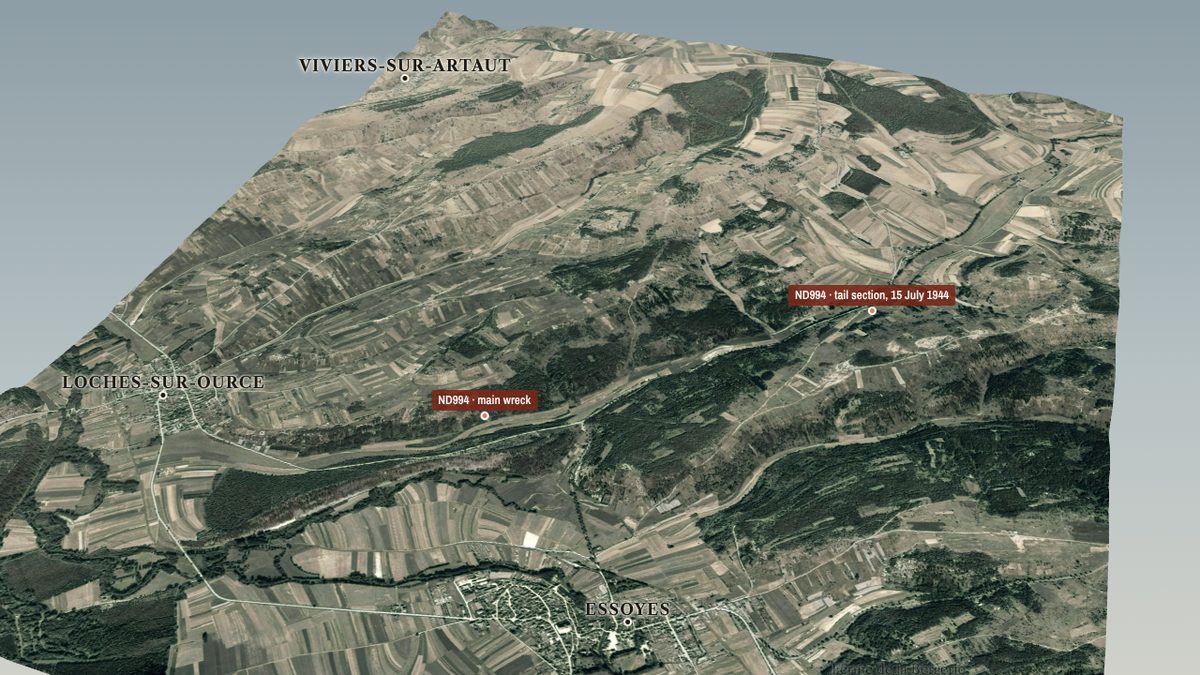 Loches and Essoyes, 1948Fly over the valley as the IGN photographed it four years after the crash. Switch between the 1948 photographs, the 1950s map, the laser relief and the land today. The photographs of the wreck stand where they were taken.Explore the valley in 1948
Sources and thanks
- Operations Record Books, Nos. 550 and 576 Squadrons, The National Archives, Kew: AIR 27/2037 and AIR 27/2047.
- Bill’s RCAF service file, R/118907, Library and Archives Canada: attestation, medical boards, record-of-service cards, gunnery training reports, conduct sheet, pay book, and the reference from John E. Madden.
- Commonwealth War Graves Commission records for all seven crew.
- Register of deaths of the commune of Essoyes, 1943–1950, entry 13, transcribed by Raymond Jeanvoine, March 2026.
- The testimony of Rolland Jeanvoine, and the research of his son Raymond Jeanvoine since 1982, including his conversations with Dr Claude Poisson and Gabriel Gloux.
- Toronto newspapers, July 1944 and April 1945.
- Letters from Ken Newman and the men of Bill’s first crew to Michael McCollum, and Michael’s research of the 1990s.
- Family records and recollections, gathered by Janet Maddocks and Michael McCollum.
- Aerial photographs and orthophotos: IGN (Institut national de l’information géographique et forestière), France.
- Colourisation: the photos marked as colourised were coloured from the black-and-white originals. Several were redone for this site: an automatic colouriser guided by colours sampled at the two sites from the IGN’s summer aerial photographs, and by the standard paint scheme of a 1944 Lancaster. The colour is an informed estimate, not a record. The original is always one movement away.
- Theo Boiten, Nachtjagd Combat Archive, 1944 Part 3, pp. 110–111, and the flying log (Leistungsbuch) of Uffz. Harry Färber, Drünkler’s gunner (collection René Brachten), for the night fighter’s claims.
With thanks to Raymond Jeanvoine of Loches-sur-Ource, to Janet Maddocks for years of family research, and to Michael McCollum, who started this work with his father, Bill’s brother Bob, before there was an internet to help.